



What Is a Customer Persona? A Practical Framework for Building One (TA ddddd)
Quốc
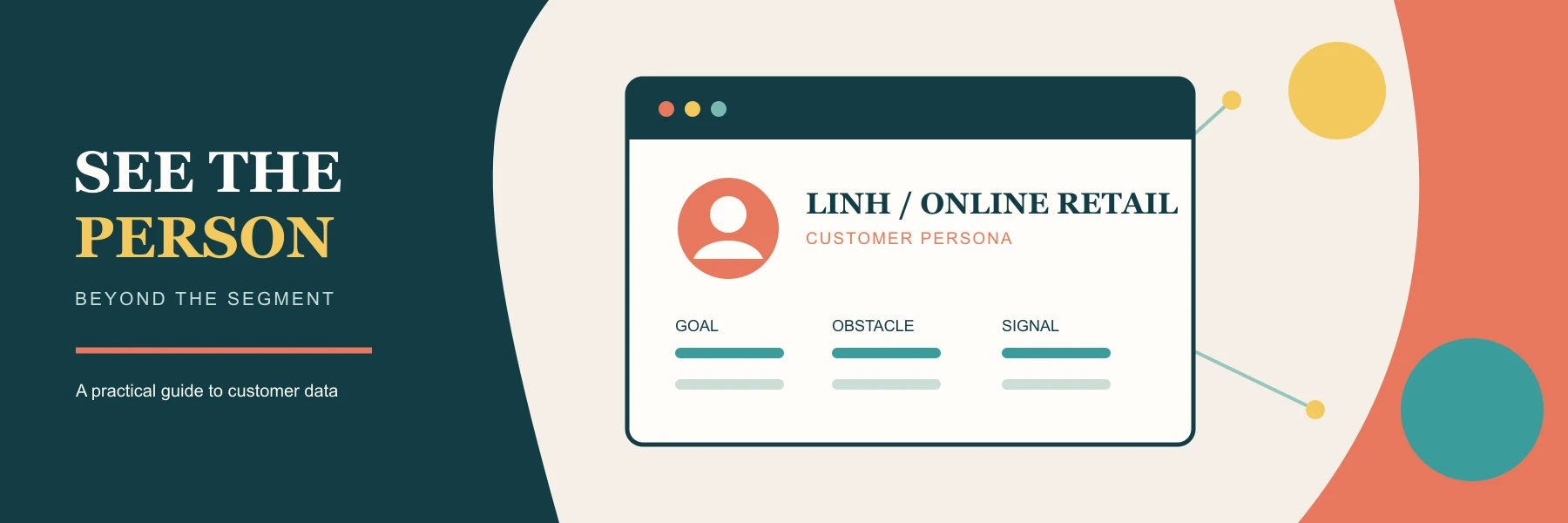
NHANod. A marketing team may know that its product is for “small businesses,” but that description is too broad to shape a persuasive message. Different owners have different goals, concerns, research habits, and buying criteria. When each team member imagines a different buyer, content becomes generic and sales has to rediscover the context in every conversation.
A customer persona is a structured description of a typical customer group, based on evidence and observation rather than guesswork. The most practical starting point is a five-part profile: context, goal, obstacle, buying behavior, and action signal. You can build the first version in a document or spreadsheet, then validate it through conversations and existing data.
What is a customer persona?
A customer persona, also called a buyer persona, is not a fictional character invented to decorate a presentation. It represents a group of customers who share relevant needs, behaviors, and buying circumstances. A useful persona helps a team answer specific questions: What is this customer trying to accomplish? What makes the job difficult? Where do they look for information? What next step would move them closer to a decision?
Nielsen Norman Group explains that effective personas should be grounded in user research. A name, age, or image may make a profile memorable, but only details that influence a design, content, or sales decision deserve space. A customer persona is therefore more than a long list of demographics.
A five-part customer persona framework
Create one page for each customer group with a meaningfully different need. Fill the five blocks with short statements, concrete evidence, and an update date.
| Block | Question | Example |
|---|---|---|
| Context | What are they doing and under what constraints? | Online fashion shop owner with three employees and several sales channels |
| Goal | What outcome would make the work better? | Answer customer questions faster without monitoring chat all day |
| Obstacle | What slows them down or delays a purchase? | Missed messages and fear that a new tool could mishandle orders |
| Buying behavior | How do they research and evaluate options? | Ask peer communities, watch a demo, and look for a reversible trial |
| Action signal | What suggests they are ready to talk? | Ask about chat integrations and human handoff |
These five blocks move the team from “women aged 25–34” to a testable working hypothesis. If a detail would not change your message, channel, offer, or service approach, remove it.
A completed customer persona example
Suppose you provide conversation support for online retail stores. A practical persona might look like this:
Representative name: Linh, an online fashion shop owner.
Context: Linh runs the shop with three employees. Customers ask about products through the website and social channels; the team often replies at the end of the day.
Goal: Reduce unanswered conversations and give customers consistent answers about products, delivery, and returns.
Obstacle: Linh has no dedicated technical specialist. She worries that an incorrect automated answer could damage trust and wants staff to take over when a question falls outside the process.
Buying behavior: Linh starts by asking other shop owners, then watches a short demo. She prefers to test one small workflow before expanding.
Action signal: Linh asks how chat channels connect, who approves answers, and how conversations move to staff.
The right message is not “automate every conversation.” A clearer direction is: “Help a small team handle repetitive questions while keeping a human handoff for cases that need judgment.” This is a content hypothesis to validate, not a claim that every shop owner has the same need.
How to gather evidence without overcomplicating the work
Start with sources the team already has: call notes, inbox questions, lost-opportunity reasons, pre-purchase questions, and post-use feedback. Group repeated observations, but preserve context so one opinion does not become a universal truth.
Then talk with customers or users at different stages. Ask about the last time they faced the problem, what they tried, what they considered, and why they chose or rejected an option. Questions about a specific event are usually more useful than “Would you like this feature?”
Finally, compare the persona with operational data. Check whether the stated questions, channels, and drop-off points appear in the records. When evidence is incomplete, label the statement as a hypothesis and set a review date instead of presenting it as fact.
Common customer persona mistakes
| Mistake | Why it fails | Better approach |
|---|---|---|
| Listing only age, gender, and income | It does not reveal the decision the person needs to make | Add context, goal, and obstacle from a concrete situation |
| Creating too many personas | The team loses its priority | Combine groups with the same problem and choose the clearest need |
| Relying on internal opinion | The profile describes the seller rather than the buyer | Tie each observation to a conversation, record, or note |
| Writing it once and forgetting it | Customer needs and behavior can change | Add an owner, update date, and signals to monitor |
| Treating the persona as research itself | A profile is still only a model | Keep validating it with interviews, feedback, and behavior |
A validation checklist
A persona is ready for a content or sales plan when you can answer five questions: Which group does it represent? Where did the evidence come from? In what situation does the problem occur? How is this group meaningfully different from another persona? Which statements are still hypotheses? Record the source and confidence level in the working document.
Review the profile when the product, market, sales channel, or customer behavior changes materially. Do not update it just to make the date look current. Update it when new evidence changes how the team should prioritize a message, experience, or workflow.
Turn the persona into a decision
A customer persona is useful when it helps the team do something more precisely: rewrite a message, choose a discovery question, prioritize a workflow, or decide what to test next. Start with one group, fill the five blocks with available evidence, mark uncertainty, and complete the profile with a real example.
Then turn it into a small test: one content page, one consultation script, or one follow-up workflow. Watch the questions, responses, and points where customers stop. Those observations will make the persona more accurate over time.
What to do next
Open a document and create five blocks: context, goal, obstacle, buying behavior, and action signal. Fill them with one recent customer situation, mark what needs validation, and share the profile with marketing, sales, and customer service so everyone uses the same working picture of the buyer.
FAQ
Recommended for you